
What the starter current test tells the workshop
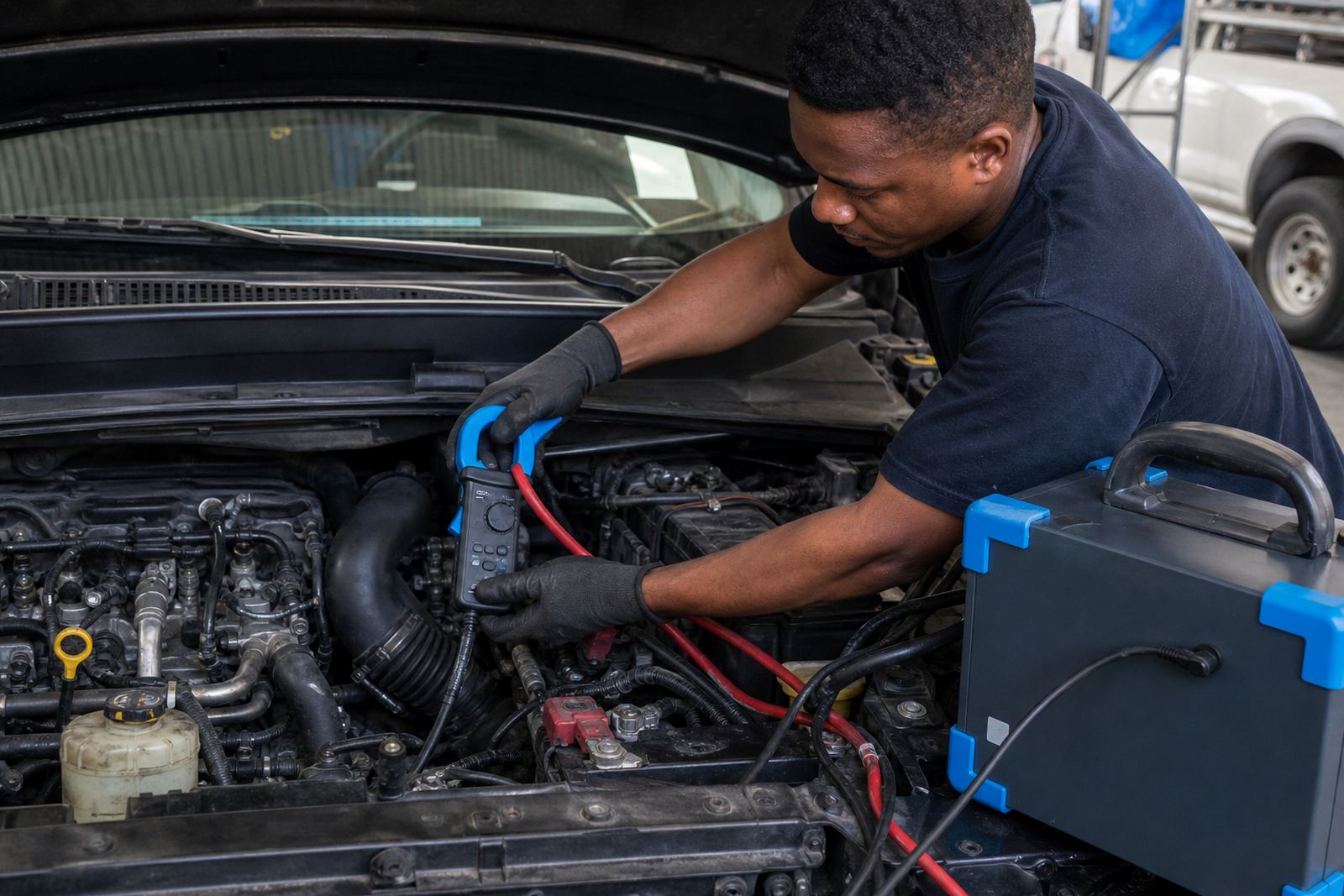
We clamp a current metre around the starter feed and watch the draw while the engine is cranked. The reading, along with battery voltage drop and cranking speed, shows whether the starter is working within a normal range or pulling too hard.
This test is useful when a vehicle turns slowly, clicks once, labours when hot, or starts fine on some days and badly on others. It gives us a current reading for the battery, cables or starter motor.
- Cranking amperage under load
- Voltage drop across the supply and earth side
- Starter engagement speed and consistency
- Signs of internal drag, worn brushes or tight bearings
When this test makes sense on a Cape Town vehicle
We use starter current testing on private cars, bakkies, panel vans, fleet units and light commercial vehicles that work around Montague Gardens, Milnerton, Bellville, Somerset West and Paarl. It suits vehicles that show repeated slow cranking, intermittent no-starts or a hard turn from the engine before it fires.
It is also useful after wiring repairs, battery drain checks or charging system work, when you need to know whether the starter itself is still pulling cleanly. On some vehicles the fault sits in the starter circuit, on others it sits in the cable run or the earth path, and the current reading helps separate those parts.
- Slow crank with a known good battery
- Repeated clicking from the starter circuit
- Hot-start trouble after short stops
- Fleet vehicles with uneven starting behaviour
How the test is carried out in the workshop or on site
Our technicians check the battery first, then the starter feed, earth points and main cable condition. After that we measure draw during cranking, compare the reading with the engine size and starting behaviour, and look at live voltage fall across the circuit.
If the readings point to a cable or earth fault, we trace that path and repair the weak section. If the starter is drawing too much current, we inspect the motor, solenoid, pinion movement and the internal parts that can make the unit drag.
- Battery voltage before cranking
- Current draw while cranking
- Voltage drop on positive and earth sides
- Starter engagement, noise and speed
Starter sizes, system types and vehicle fitment notes
Starter current testing is not one fixed size job. Small petrol engines, diesel bakkies, turbocharged work vehicles and larger fleet units all show different draw patterns, so we match the test to the vehicle and its starting system. We also take note of whether the vehicle uses a traditional key start, relay-controlled starter circuit or a more complex module-managed system.
On many vehicles the starter circuit is closely tied to battery condition, charging output and earth integrity. That is why a weak alternator, loose battery terminal or damaged cable can show up as a starter problem, even when the motor itself is still serviceable.
- Petrol and diesel starting systems
- 12 V and 24 V applications
- Manual and automatic transmission layouts
- Standard cable start or module-controlled circuits
Care after the reading is taken
Once the test is done, the best next step is to keep the battery charged correctly, keep terminals tight and clean, and make sure earth straps stay free of corrosion. A starter that has been dragging for weeks can heat up the cables, so we also check for soft insulation, discoloured terminals and tired connectors.
For fleet vehicles, regular electrical checks help catch a weak starter before it becomes a roadside no-start. In coastal Cape Town conditions, salt air and moisture can speed up corrosion on terminals, fuse links and earth points, so a periodic inspection is worth the time.
- Keep battery posts and clamps clean
- Check earth straps for corrosion and looseness
- Inspect heat marks on cables and terminals
- Repeat testing after any charging system repair
What to confirm when booking the test
When you send your details through our contact form, include the vehicle make, model, engine type and the symptoms you are seeing. If the starter has already been replaced, tell us that too, because a replaced unit with the wrong draw pattern can point back to wiring or battery supply issues.
It also helps to mention whether the vehicle is a fleet unit, a private vehicle, or part of a mobile call-out job in the Western Cape. That gives us the right setup for current measurement, cable tracing and starter circuit checks, whether the work is done at our Montague Gardens workshop or on site.
- Vehicle year, model and engine type
- Petrol or diesel
- Hot-start or cold-start symptom
- Recent battery, starter or alternator work
Key facts
| Test method | Clamp metre current draw check with voltage drop testing |
|---|---|
| System range | 12 V and 24 V starting systems |
| Typical checks | Cranking amperage, supply voltage, earth loss, starter engagement |
| Vehicle types | Passenger cars, bakkies, vans, light fleet units |
| Service areas | Montague Gardens, Cape Town, Bellville, Milnerton, Somerset West, Paarl |
| Workshop base | Montague Gardens, Cape Town with mobile call-outs across the Western Cape |