When a tidy fitment still leaves a flat battery
A tracker, dash camera, fridge plug or extra lighting can look neatly installed and still pull current when the vehicle is parked. The trouble is not always the accessory itself, it is often the way the circuit was picked up, fused, or switched. A low drain adds up over a weekend, and in Cape Town humidity corroded joins can make the current path worse.
We see this in private cars, bakkies and fleet units that spend long hours off the road. One vehicle may have an alarm feed shared with a constant live wire, while another loses battery life because an accessory earth sits on painted metal instead of clean metal. Small errors hide well until the battery starts going flat for no obvious reason.
- Constant live feeds left on after key-off
- Poor earth points with rust, paint or loose fasteners
- Relays wired incorrectly for the load being carried
- Chafed cables near hinges, trim clips or engine parts
What battery draw looks like on a real fault check
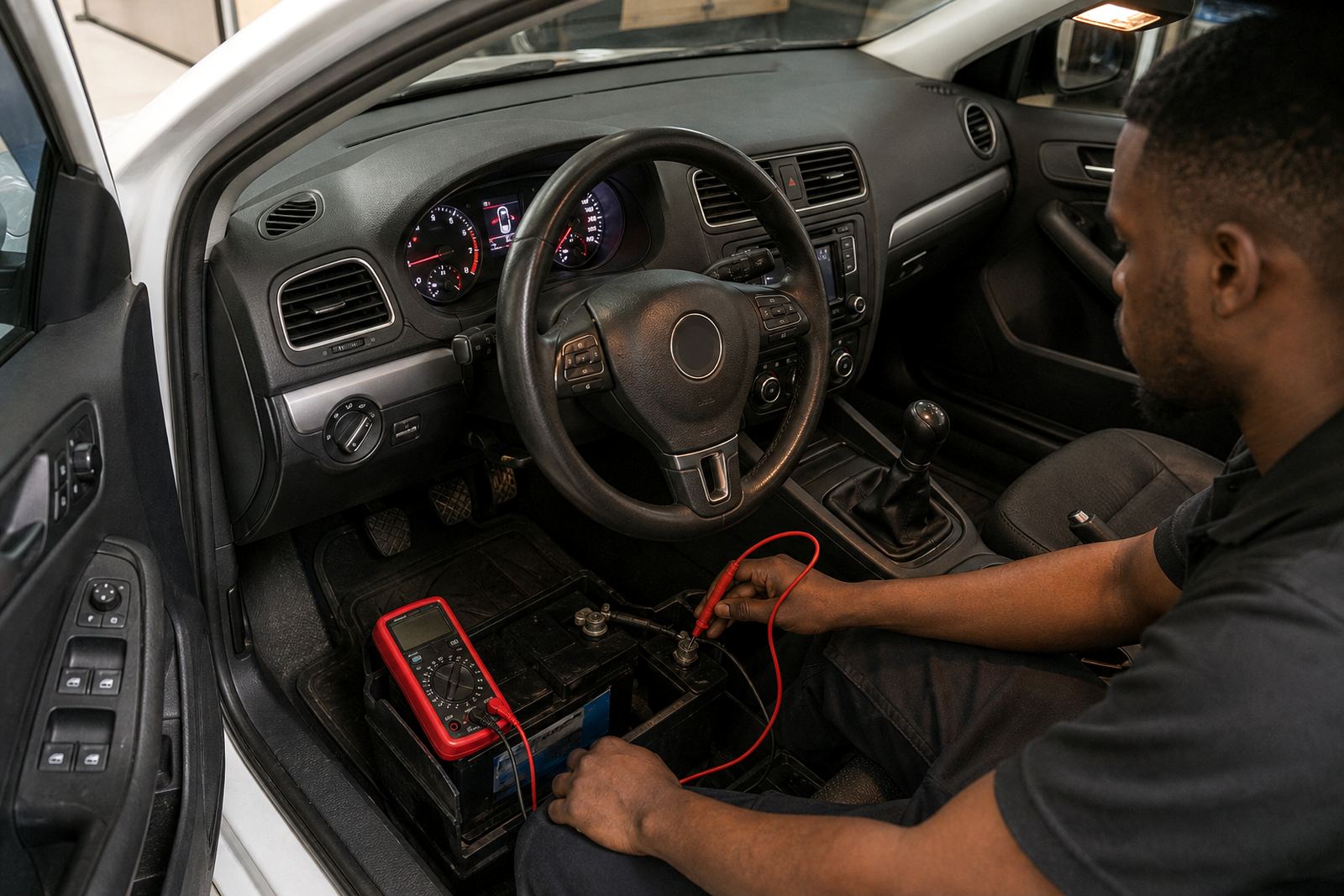
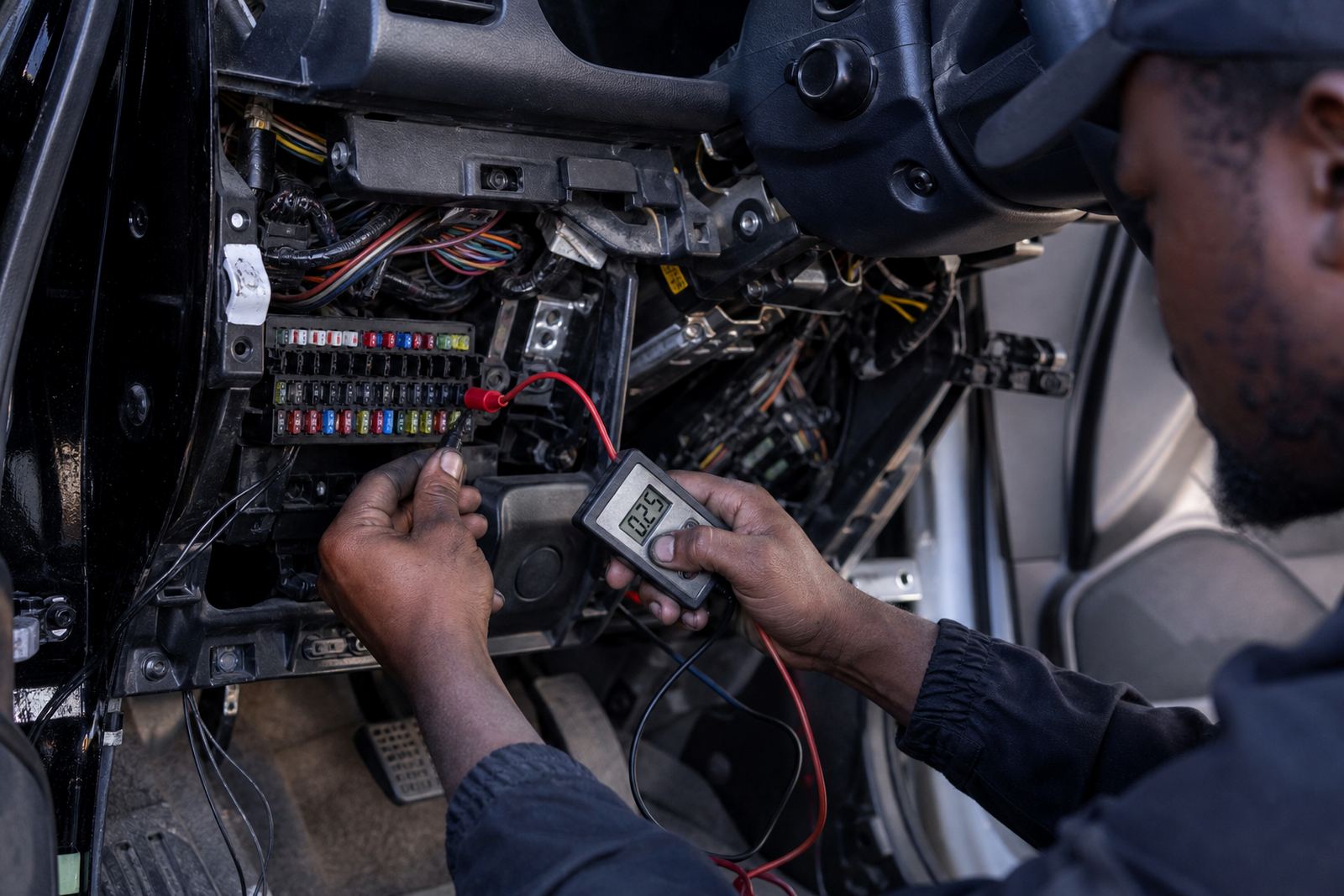
A proper draw test starts with the battery itself, then the charging system and the sleep current once the vehicle has settled. Technicians read OBD fault codes where they matter, then check live data, fuse circuits and the main cable runs. If a starter or alternator has already begun to fail, that fault can sit beside the accessory drain and confuse the picture.
On newer vehicles, a CAN bus circuit can stay awake too long if a module or add-on accessory wakes it repeatedly. On older vehicles, the issue is often simpler: a stuck relay, a lamp circuit that never shuts down, or a radio harness that was altered without checking the full path. Either way, the current has to be measured.
- Battery condition and resting voltage
- Alternator output and ripple checks
- Parasitic draw after key-off
- Fuse-by-fuse isolation to find the drain
- Wiring integrity at the accessory point
Power sources that keep the vehicle sleeping properly
The cleanest fitment is usually the one that powers the accessory from the right source for the job. Some items need a permanent feed with its own fuse, while others should only live when the ignition is on. If that choice is wrong, the accessory can stay active when it should be asleep, or wake other circuits through a shared line.
We also inspect the quality of the connections. Crimps, soldered joins and loom wraps each have a place, but only when the cable size and current draw match the application. A GPS unit may draw very little, yet a cluster of accessories mounted together can add enough load to expose weak wiring or poor earthing.
- Tracker fitment with a stable fused supply
- Accessory relays matched to the load
- Separate earth return where the body metal is poor
- Heat-shrunk joins in exposed engine bays
A Montague Gardens job that started with a dead battery
A delivery bakkie from Bellville came in after the battery went flat twice in a week. The owner had added work lights, a tracker and a charging point for handheld gear. The fitment looked neat at first glance, but the draw test showed a small constant drain that stayed active after the ignition was off. One accessory feed had been taken from a circuit that never fully slept.
Once the wiring was traced, the fault was isolated to the wrong feed and a tired earth point nearby. The circuit was moved, the earth cleaned, and the charging system checked again. The vehicle then held a normal sleep current and the battery no longer dropped away after standing over a weekend.
That is the kind of fault that can waste time across Milnerton, Somerset West or Paarl if the first check is only visual. A tidy trim panel does not prove the circuit is correct. The metre does.
Symptoms that point to accessory drain rather than battery age
Some batteries are simply worn out, but accessory drain leaves a few clues behind. The vehicle may start fine after a long drive, then struggle after a short stop or an overnight park. The issue can feel random because the drain only shows when the added equipment is fitted and the vehicle goes into rest mode.
- Battery goes flat after standing for a night or two
- Dash lights, trackers or radios stay active after shutdown
- Fuses run warm or show signs of repeated replacement
- Charging tests pass, yet the battery still drops
- Faults appear after a recent install or rewiring job
At that point it helps to separate battery health, alternator output, and current draw. A vehicle can have a healthy alternator and still sit dead because an accessory is sipping power all the time.
How V-Auto handles battery draw after fitment
We work from Montague Gardens and carry out mobile call-outs across Cape Town, Bellville, Milnerton, Somerset West, Paarl, Brackenfell and Durbanville. On this kind of fault, the job usually starts with a battery test, then a charging system check, then a measured search for parasitic drain. If wiring repairs are needed, the loom is traced back to the source and repaired with the right fuse protection and cable routing.
Our workshop also handles starter repairs, alternator repairs, battery drain repairs, charging system repairs, lighting repairs, fuse box repairs, earth fault repairs, starter circuit repairs, trailer wiring repairs, accessory rewiring and CAN bus fault checks. That matters when the drain is not a single fault, but a chain of small issues left behind after fitment or modification.
If your vehicle started going flat after a new accessory was fitted, our contact form is the easiest way to send the details. A short note on what was installed, where the vehicle is based, and when the fault started helps us plan the right check. The aim is to find the drain, repair the circuit and leave the electrical system working as it should.