What the first turn of the key is telling you
When a vehicle will not start, the first clues sit in the cranking pattern. Some units turn the engine over slowly, some click once and stop, and some spin freely but never fire. Each pattern points the diagnostic path in a different direction, so the test begins there before any parts are removed.
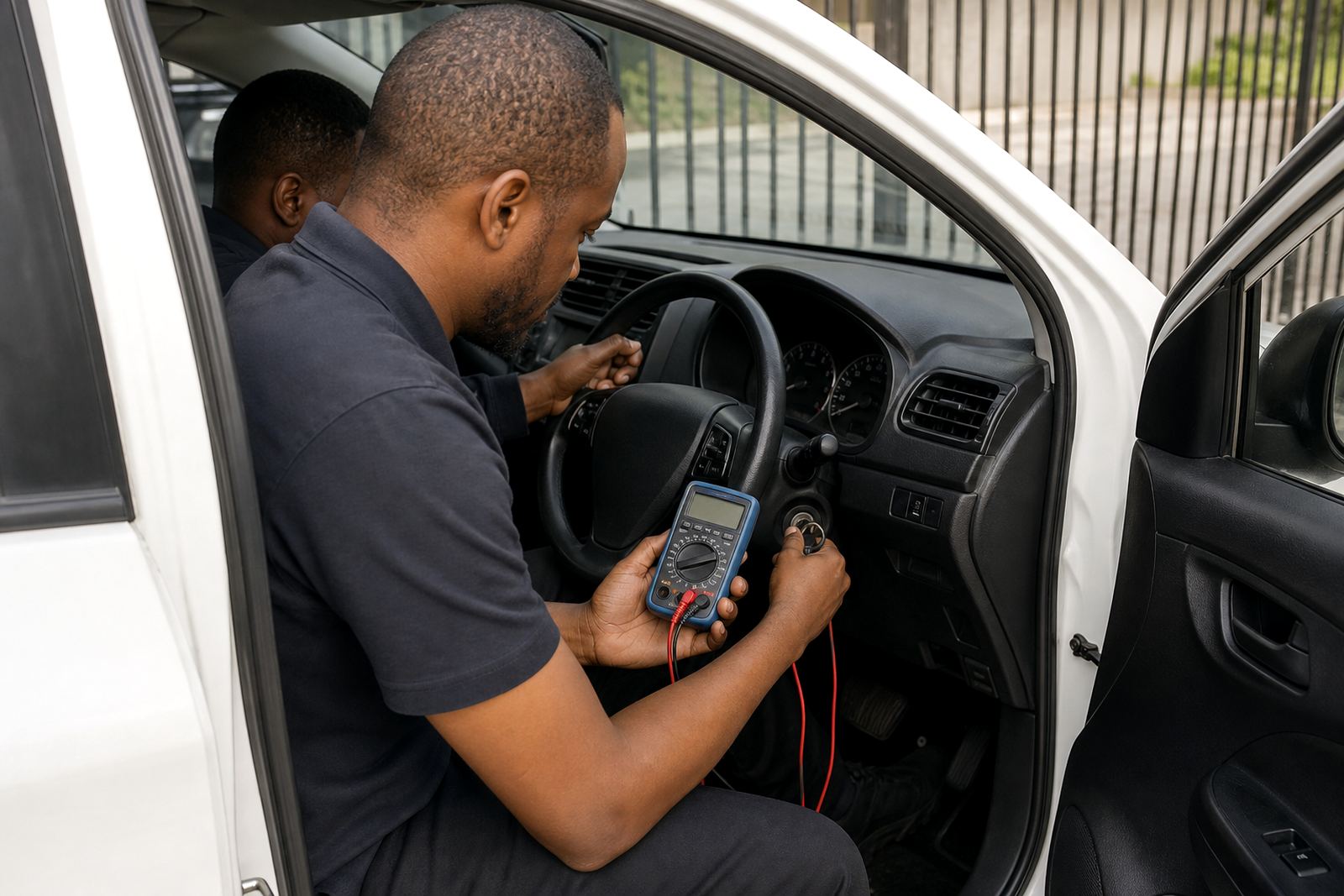
We look at battery voltage at rest, voltage under load, starter draw, terminal condition and earth quality. A weak battery can mask a starter fault, and a poor connection can look like a dead battery. In the Western Cape, coastal moisture and short trips around Cape Town, Milnerton or Bellville often leave terminals dirty and charging systems under strain.
- Slow crank with lights dimming can point to voltage loss.
- Single click faults often sit in the starter circuit or relay path.
- No crank with full dash power can still be a wiring or immobiliser related issue.
- Repeated jump-starts without a proper test usually hide the real fault.
Fault codes help, but they do not finish the job
OBD fault codes are useful, yet they are only part of the picture. A code may show a low voltage event, a crank sensor signal issue, or a communication fault on the CAN bus, but that does not always mean the part named in the code is the part that failed. We read live data beside the code list and compare the readings with the cranking behaviour.
On some vehicles, a starter fault can trigger engine management codes because the control unit never sees a clean cranking signal. On others, a flat battery can create a spread of unrelated warnings. That is why the sequence matters. Code review, voltage testing, and visual checks must work together if the diagnosis is going to hold up.
- Fault memory can point to supply loss, not just component failure.
- Live data shows whether sensors and modules are waking up as expected.
- CAN bus faults may sit in a connector, splice or damaged line rather than a module.
Supply checks that expose hidden problems
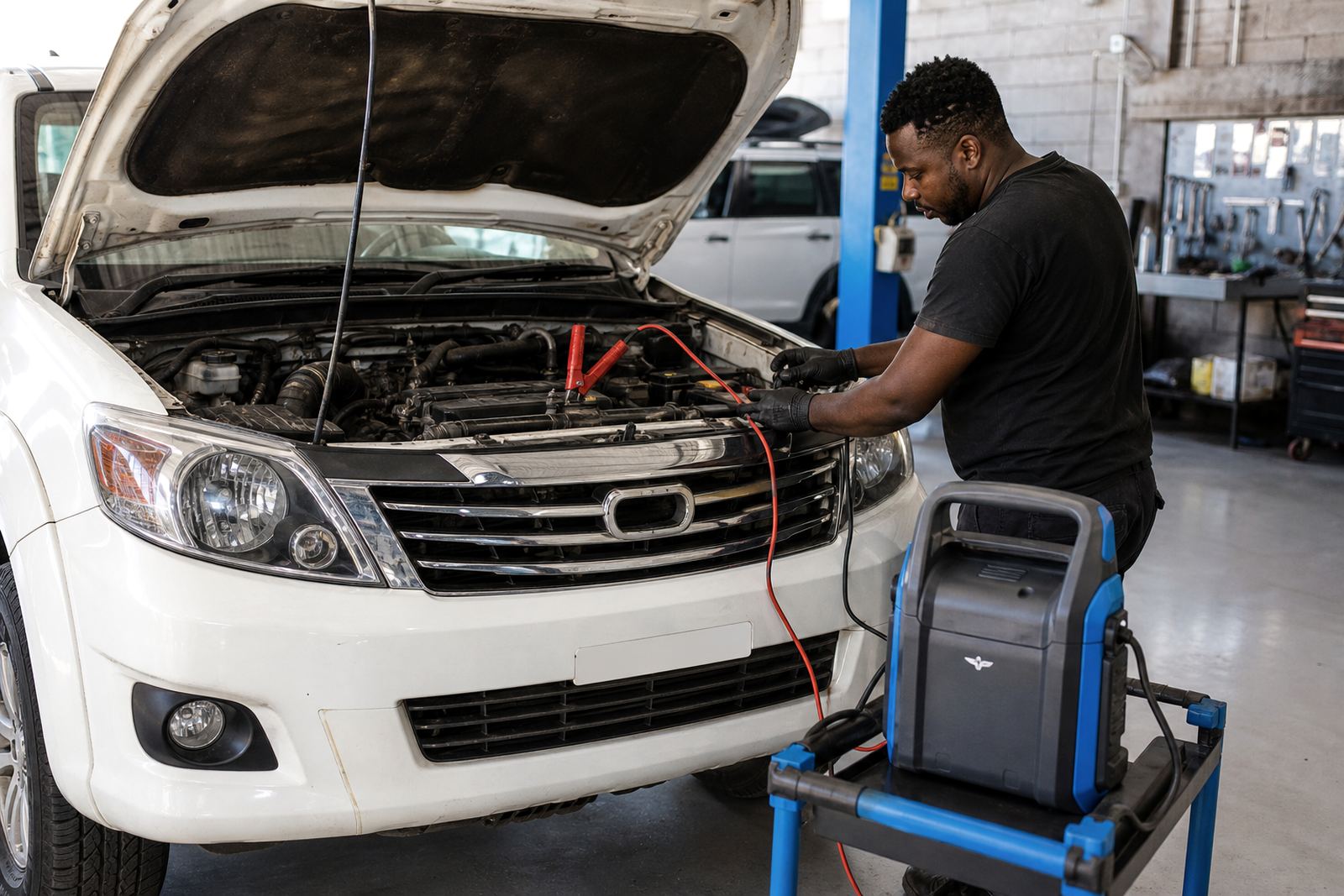
Most no-start jobs pass through the same basic supply checks. We test battery condition, charging output, parasitic drain and voltage drop across the main cable runs. A battery can appear fine on a charger, then collapse as soon as the starter load is applied. Charging output can also look present at idle, yet fall away once the vehicle is loaded with lights, blower and rear demister.
Parasitic drain is common on fleet vehicles that stand between routes in Montague Gardens or in storage yards near Paarl. A tracker, accessory relay, glovebox lamp, aftermarket audio unit or a damaged wiring branch can keep drawing current after the vehicle is switched off. That drain may flatten a battery overnight, leaving the driver with a no-start the next morning.
- Battery health is checked under load, not by appearance alone.
- Alternator output must be measured at the battery and at the main feed.
- Drain testing helps separate a stored battery fault from an active circuit fault.
- Loose grounds can cause intermittent starting faults that seem random.
Starter and alternator faults that look alike
A starter that drags slowly and an alternator that has not charged properly can produce similar symptoms. Both leave the battery too weak for the next start. The difference is in the evidence. A starter fault shows up when current demand rises sharply during cranking. An alternator fault shows up after the engine has been running and the battery never recovers to a healthy charge level.
We test the starter circuit from the ignition trigger to the solenoid and main feed. On charging systems, we check belt condition, output ripple, connections and the condition of the earth path. If the battery warning light is on or the vehicle has had repeated flat batteries, the charging system needs a proper test before any replacement is considered.
In a Cape Town call-out, a vehicle that starts after a jump but dies again after a short drive often has more than one issue. The battery may be tired, while the alternator regulator or charge cable is also underperforming. That kind of fault needs proper tracing.
Wiring faults, earth faults and CAN bus basics
Not every no-start job is a component failure. Wiring repairs take up a fair share of the work because heat, vibration, water ingress and poor previous repairs all break continuity. A cracked wire inside insulation can pass a visual inspection yet fail under load. Earth faults are especially common, and they can create strange symptoms across several systems at once.
CAN bus faults need a steady, methodical approach. If a module cannot communicate, the issue may be in a corroded connector, a damaged twisted pair, a bad earth or a short in an accessory circuit. We trace the network basics first, then isolate the branch that is disturbing the rest of the system.
- Broken earth straps can stop cranking or corrupt sensor readings.
- Fuse box faults may look minor but can cut power to key circuits.
- Aftermarket tracker wiring must be checked where it ties into the loom.
- Trailer wiring damage can feed faults back into lighting and charging circuits.
A Montague Gardens case that was not just the battery
A private owner from Somerset West brought in a vehicle that would start after a boost, then fail again after standing for a day or two. The battery had already been changed, so the first assumption was another weak battery. The test path said otherwise. Cranking current was high, charging output was uneven, and a small parasitic drain stayed active after key off.
We traced the draw to an accessory circuit that had been tied into the loom without proper protection. The vehicle also had a tired earth point near the body, which made the starter work harder than it should. Once the wiring was repaired and the charging fault cleared, the no-start condition stopped repeating. Jobs like that are common across fleet units and private cars because one weak point can pull the whole system down.
That is why no-start checks need patience. A battery, starter, alternator and wiring fault can live in the same vehicle at the same time, and each one can hide the next if the tests are rushed.
What we handle in the workshop and on call-out
Our workshop in Montague Gardens handles no-start diagnosis for fleet and private vehicles, and our mobile call-outs cover Cape Town, Bellville, Milnerton, Somerset West, Paarl, Brackenfell and Durbanville. Some faults are best checked on site, especially when a vehicle is stuck at a depot or at home. Other jobs need the vehicle on the lift, with proper access to the starter, alternator, fuse box and wiring runs.
Typical no-start work includes starter repairs, alternator repairs, charging system testing, battery drain repairs, wiring repairs, fuse box faults, earth fault tracing, starter circuit repairs and accessory rewiring. When the fault sits inside the network or on a tracker-linked circuit, we test that path before any parts are changed. The contact form is the best place to send the vehicle details and the symptoms you are noticing.