
A battery that dies twice is rarely the real problem
When a vehicle keeps arriving with a flat battery, the first replacement often buys only a short pause. The real fault may be a tired alternator, a starter that draws too much current, a relay that stays live, or a tracker and accessory circuit fitted badly after the fact.
In our workshop in Montague Gardens we treat repeated flat batteries as a fault finding job, not a parts swap. That means testing the battery, checking charging output, looking at parasitic drain, and tracing how the vehicle behaves while parked and while running. A battery can be new and still be flattened by a hidden draw overnight.
For fleet owners in Cape Town, Bellville or Milnerton, the pattern often shows up as the same bakkie or sedan needing a jump start after a weekend standstill. Private owners in Somerset West and Paarl see the same thing after a few days of parking. The place to start is not with the battery label, it is with the current path.
What proper testing looks like in a real workshop
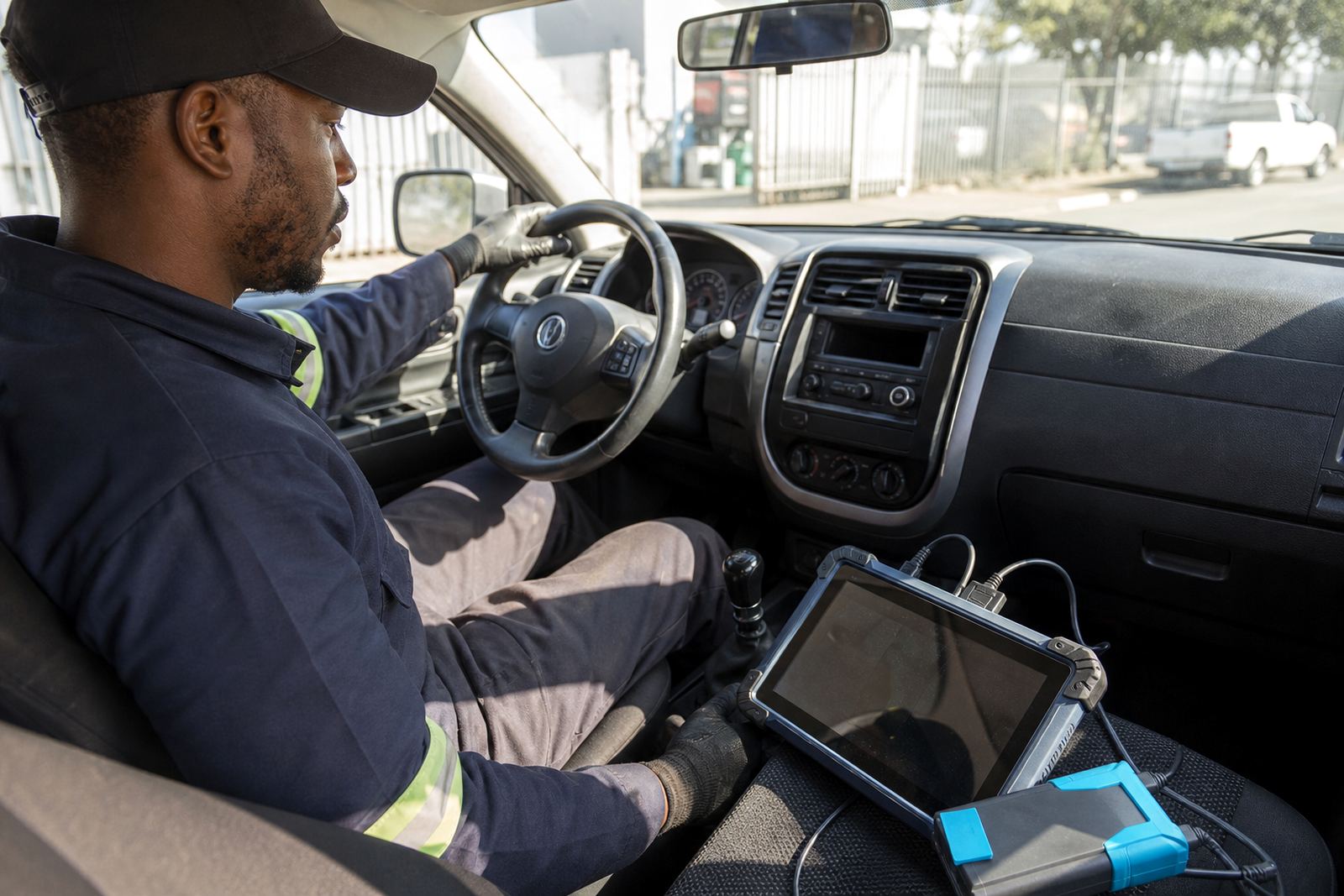
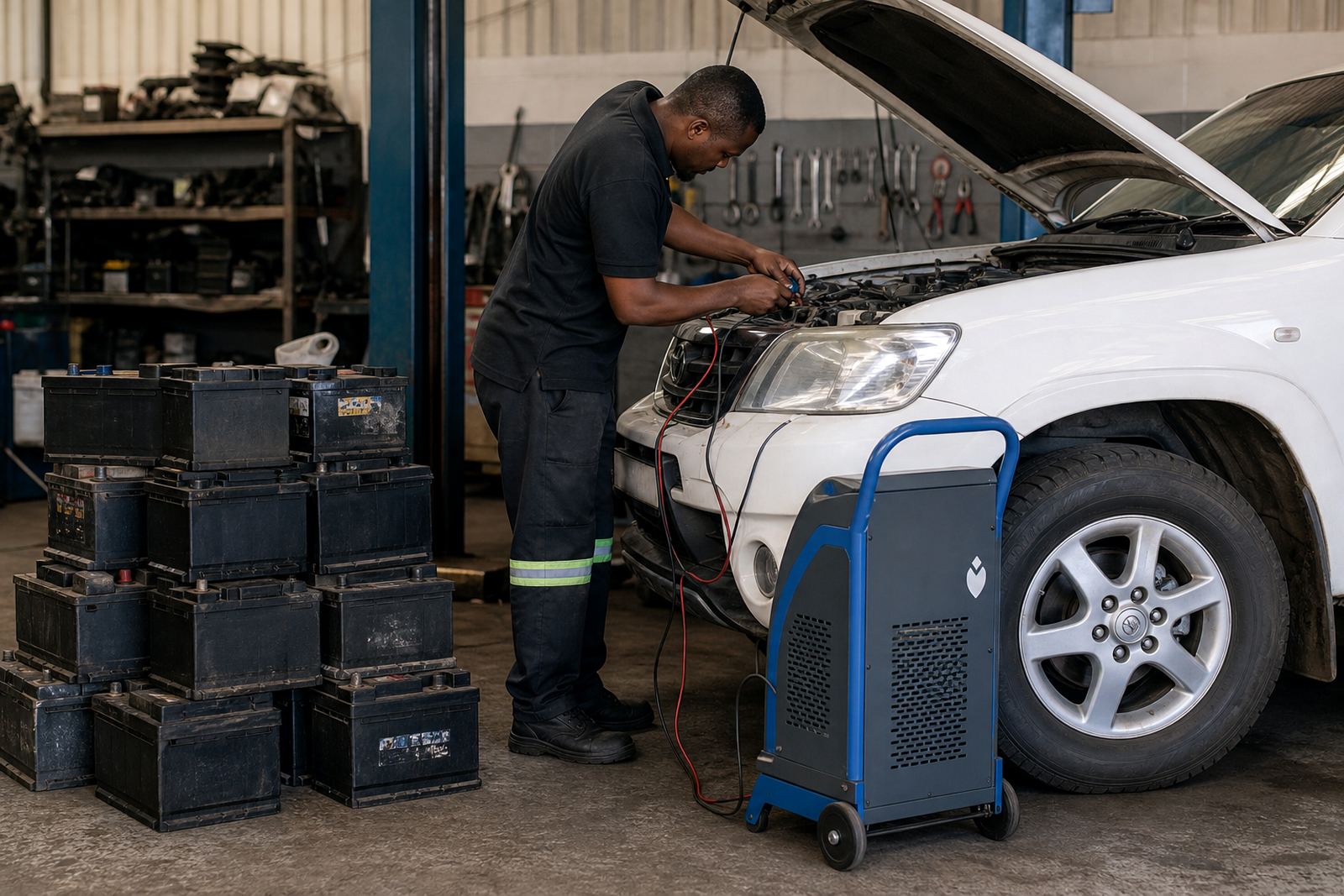
We begin with the basics and work outward. Battery condition, alternator output, starter draw, earth integrity and fuse box behaviour all matter. On many vehicles we also read OBD fault codes and live data so the charging system story matches the electrical symptoms.
- Battery load test and resting voltage check
- Alternator output under idle and raised engine speed
- Starter current draw and cranking behaviour
- Parasitic drain test with the vehicle locked and at rest
- Earth fault checks across body and engine grounds
- Fuse box and relay inspection for stuck circuits
That process shows whether the battery is being overworked, undercharged or slowly drained. We also avoid replacing parts that are still in good working order. A good test sheet saves time and prevents a second round of the same fault a week later.
The hidden drains that keep showing up
Parasitic drain is one of the most common reasons for repeat flat batteries. A vehicle should draw very little current when it is switched off and fully asleep. If it does not, something remains awake and keeps pulling power from the battery through the night.
Common causes include interior lights that never shut off, a glove box switch fault, a relay that sticks, corroded wiring, a tracker or accessory wired into the wrong feed, or a control unit that does not go to sleep properly. CAN bus faults can also disturb the shutdown sequence and leave modules active for longer than they should be.
We trace the drain step by step. The fault may be small, but the battery pays for it every day. A current draw that looks minor on paper can still flatten a battery fast enough to leave a driver stranded at the gate or in a parking bay.
- Accessory wiring joined into the wrong circuit
- Damaged wiring inside a door jamb or tailgate loom
- Aftermarket tracker or sound system issues
- Corroded fuse contacts
- Failing alternator diode leakage
When starters and alternators are part of the story
Not every repeat flat battery comes from a parked drain. Sometimes the vehicle charges poorly on the move, or the starter asks for more current than it should. A weak alternator can leave the battery undercharged after short trips, while a tired starter can drag voltage down every time the key is turned.
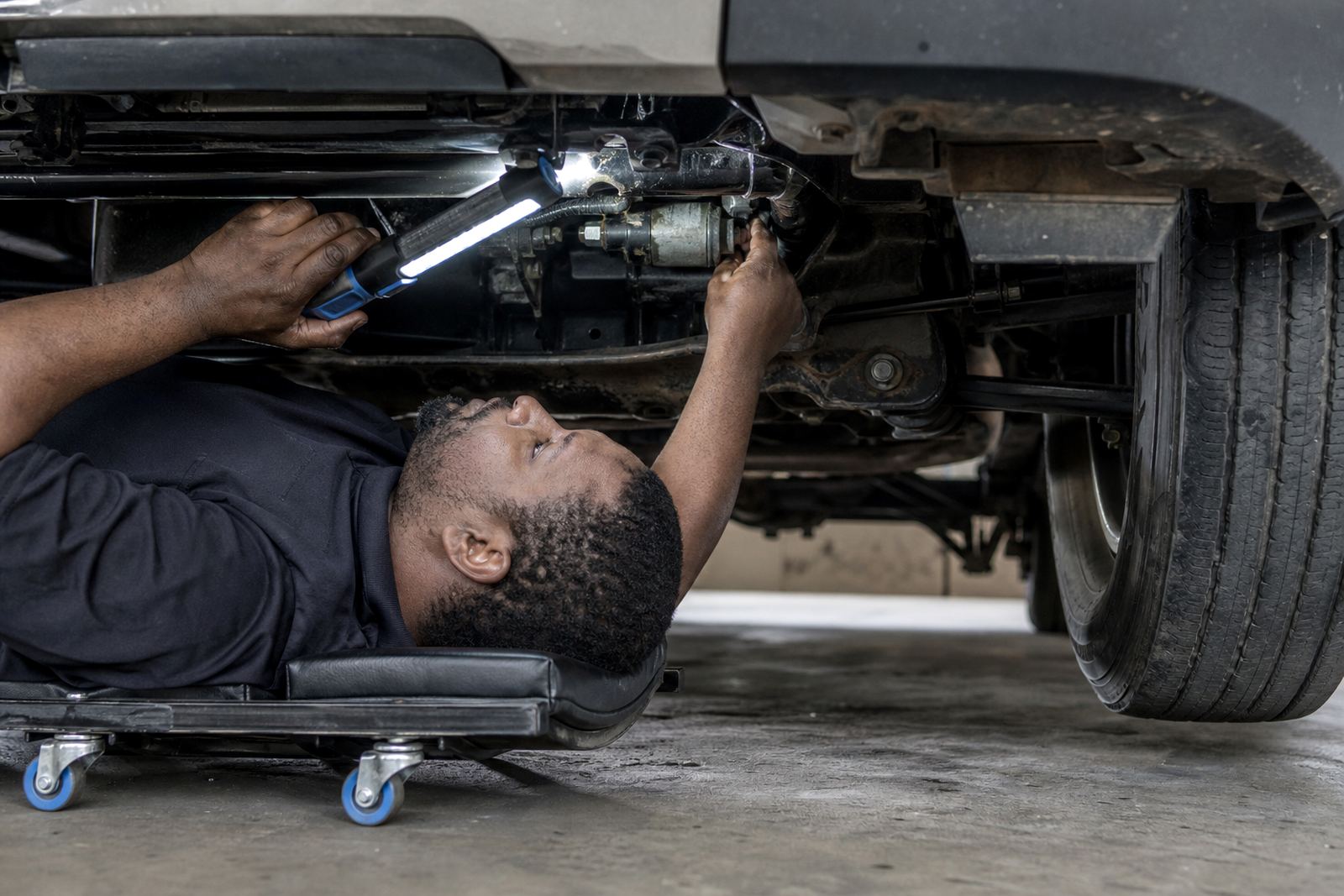
That is why charging system repairs and starter repairs go hand in hand with battery testing. We check alternator drive, output stability, wiring to the battery, and the condition of the heavy cables and earth points. On some vehicles, a worn connection inside the starter circuit creates a voltage drop that only appears under load.
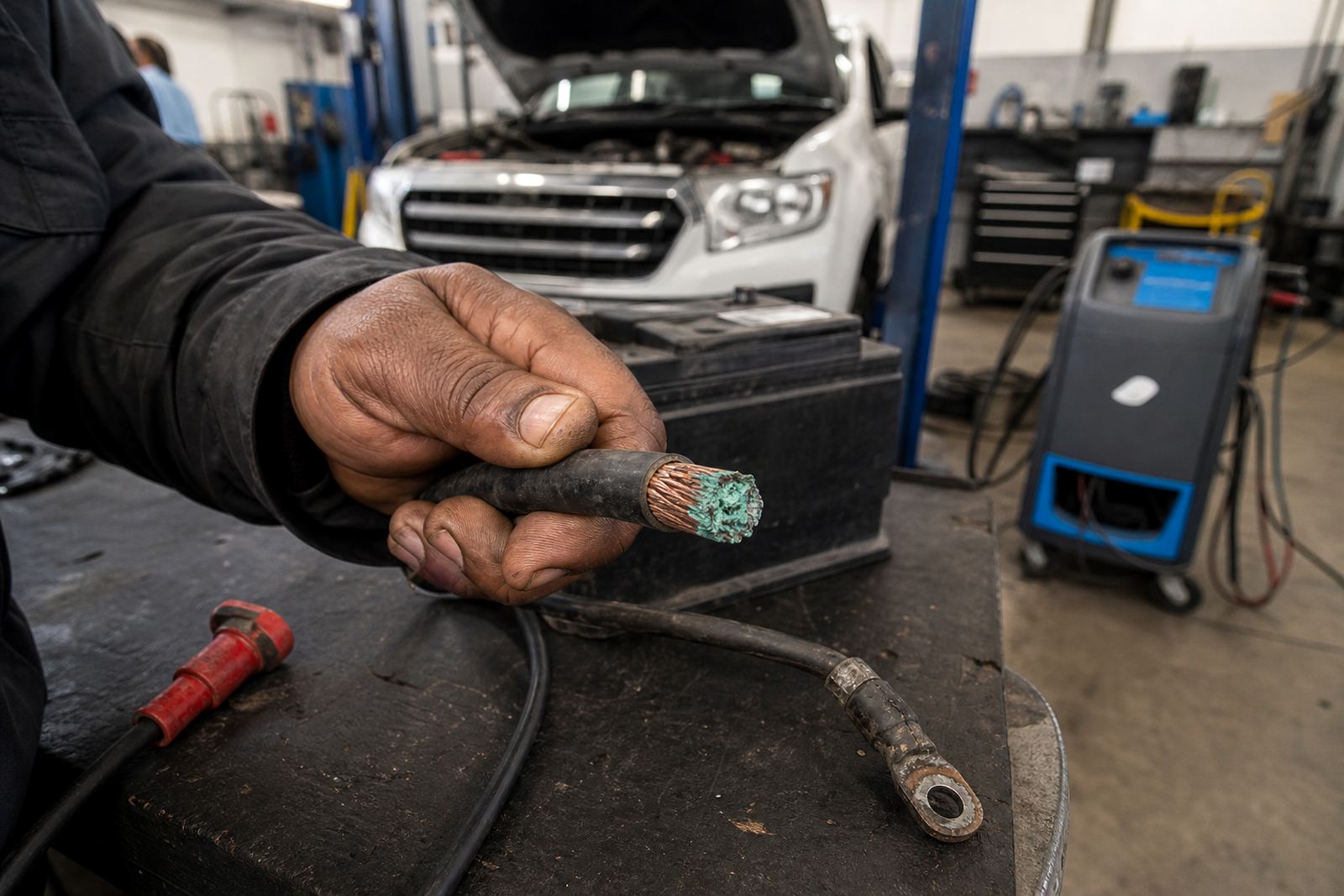
At our workshop we also inspect battery terminals, cable ends and earth straps for heat damage, green corrosion and loose clamping. In coastal Cape Town air, moisture and salt can speed up corrosion, especially on vehicles working near the harbour or parked close to the coast. A poor connection can look minor but act like a major fault.
Mobile call-outs for fleets that cannot keep guessing
For fleet operators across the Western Cape, repeated flat batteries can knock a day off the schedule before the fault is even understood. That is where our mobile call-outs help. We visit vehicles in Cape Town, Bellville, Milnerton, Somerset West, Paarl, Brackenfell and Durbanville to inspect the fault on site where practical.
Mobile testing is useful when the battery fails only after overnight standing, or when a fleet unit keeps returning with the same complaint. We can check the charging system, inspect visible wiring damage, test for drain and decide whether the vehicle needs workshop repairs or a more focused strip-down. That keeps the diagnosis tied to the actual fault rather than to the nearest spare part.
For private owners, a call-out can be enough to confirm whether the issue sits with the battery, the alternator, or an accessory circuit. For fleets, it also helps separate one-off driver issues from a pattern across several vehicles with similar use.
Montague Gardens delivery vehicle battery drain
A small delivery vehicle came into our Montague Gardens workshop after three flat batteries in a month. The battery had already been replaced once elsewhere, and the problem returned after the vehicle sat over a weekend. At first glance it looked like a simple battery failure.
We carried out a parasitic drain test, checked live data and inspected the accessory wiring. The drain only showed itself after the ignition was off and the vehicle had settled down. The issue was traced to an added accessory feed joined into a circuit that stayed live far longer than it should. Once the wiring was corrected the battery held its charge and the fault stopped repeating.
That kind of job is common enough to be familiar, but each vehicle still needs its own test path. Repeat flat batteries are usually a clue, not the conclusion.
- Start with battery health, not replacement alone
- Check the charging system under real load
- Measure drain with the vehicle at rest
- Inspect earths, relays and accessory wiring
- Read fault codes where the vehicle supports it
What our team looks at before the job is signed off
Our team includes Vuyani Mthembu, Anele Khanye, Ridwaan Davids, Megan Maluleke, Sipho Gamieldien and Liezl Botha, with each person handling a different part of the job flow. That matters on electrical work because a battery issue can sit in the workshop notes, the diagnostic test, the repair stage or the booking detail all at once.
We handle wiring repairs, starter repairs, alternator repairs, battery drain repairs, charging system repairs, lighting repairs, fuse box repairs, earth fault repairs, starter circuit repairs, trailer wiring repairs, accessory rewiring and CAN bus fault checks. A recurring flat battery may only need one of those fixes, or it may need two linked faults sorted together.
If the same battery keeps going flat, the answer is usually in the circuit that is pulling power, not in the battery case itself. Once that path is found and repaired properly, the vehicle starts behaving like it should.