

What voltage drop shows on a live circuit
Voltage drop is the loss of electrical pressure across a wire, connection or component while current is flowing. In a vehicle, that loss can make a starter crank slowly, a light glow weakly, or a battery look flat when the battery itself is not the main fault.
A continuity check only tells you that a path exists. It does not show how much resistance is hiding in a corroded terminal, a loose earth strap, a heat damaged connector, or a cable that has broken strands inside the insulation. That is why a live test matters more on a working vehicle.
Where the hidden resistance usually sits
On Cape Town vehicles we often see voltage drop appear in places that carry high current every day. Starter circuits, battery cables, alternator output leads and body earth points take the brunt, especially when the vehicle works near the coast and moisture gets into terminals. A small amount of corrosion can create a big problem once the system is under load.
- Battery terminals with light green or white corrosion
- Loose engine or body earth straps
- Damaged fuse box terminals
- Worn starter solenoid connections
- Heat damaged alternator wiring
- Accessory wiring added without proper protection
How we test a fault
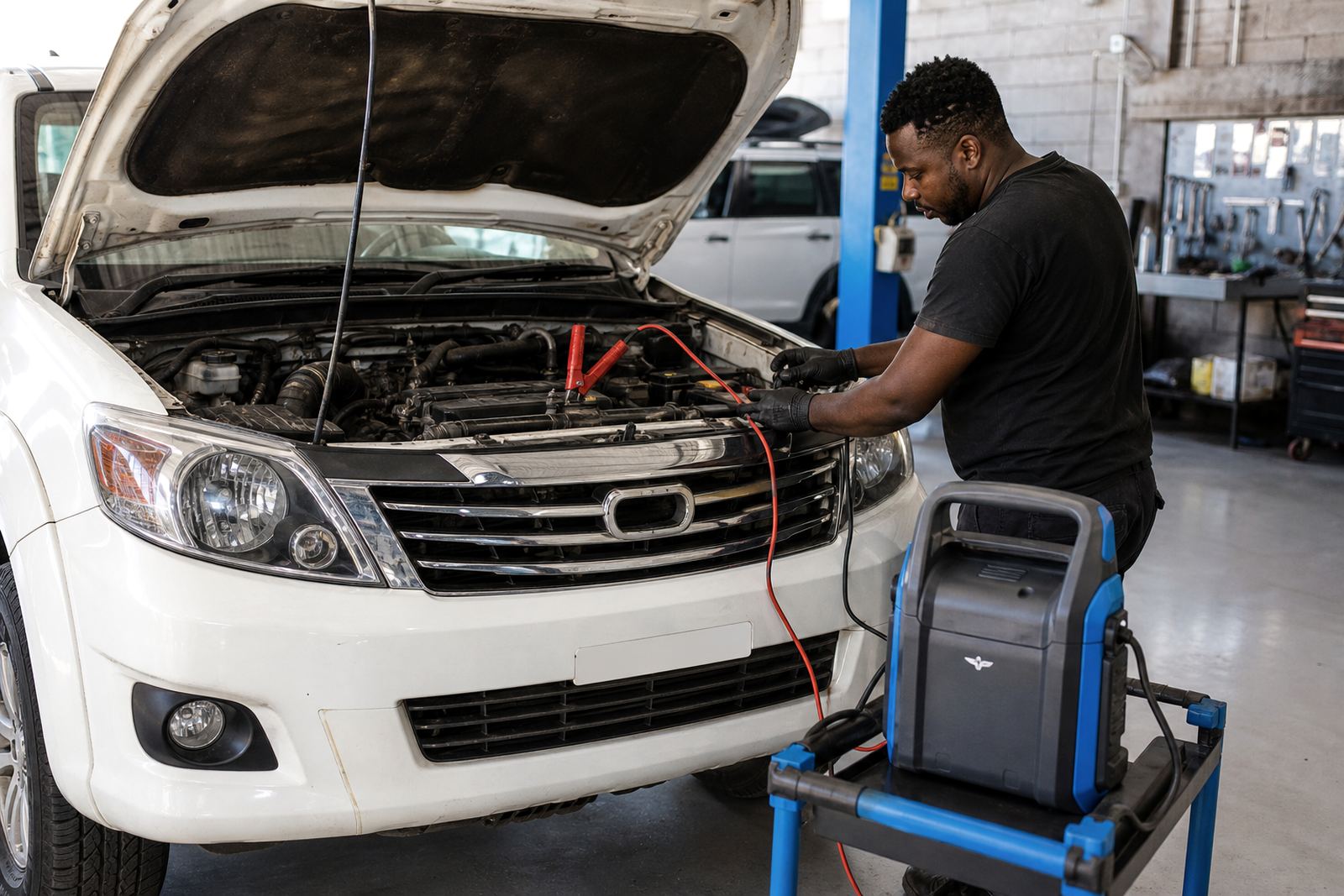
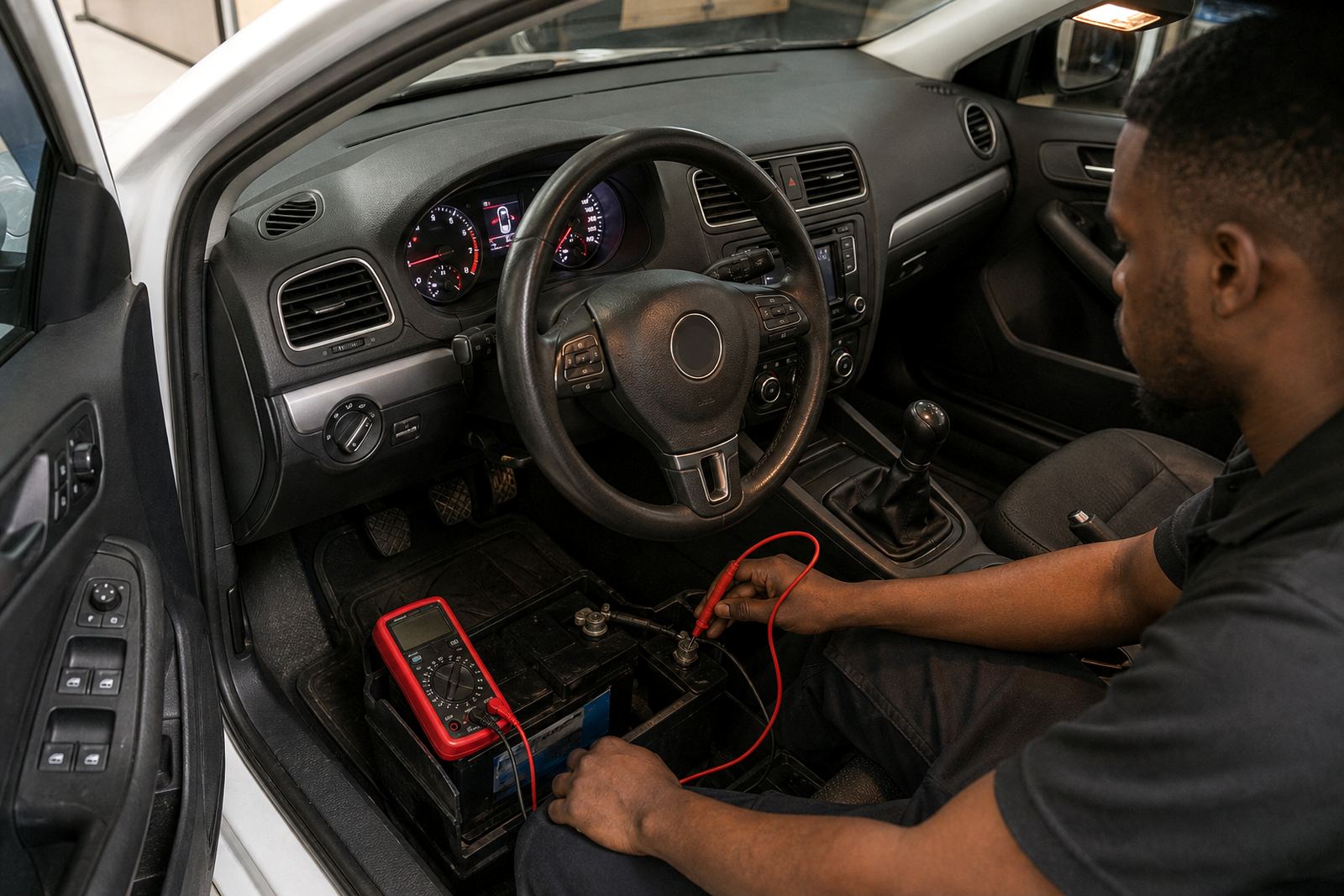
Our workshop in Montague Gardens uses live data, battery and charging tests, and voltage drop readings together. That gives a better picture than one test on its own. If a starter drags, we can measure the positive side and the earth side separately, then see whether the loss sits in the cable, the relay, the switch side or the starter itself.
For charging faults, we check alternator output, battery condition, belt drive condition where relevant, and the voltage path back to the battery. A charging system can show the correct output at one point and still fail to deliver it to the battery because the path is restricted.
- Measure across the positive cable while cranking
- Measure across the earth path while cranking
- Compare battery voltage at rest and under load
- Check live charging values at idle and with electrical load
- Inspect connector heat marks and terminal tension
Why a continuity beep can miss the problem
A continuity tester only needs a small current to sound a beep. A cable with a few broken strands may still pass that test, yet fail badly when the starter asks for heavy current. The same applies to an earth point that reads fine on a metre but cannot carry the load of headlights, fans and a starter motor at the same time.
That is why voltage drop testing is useful on wiring repairs, starter circuit faults, alternator complaints and battery drain work. It shows the circuit under strain, which is closer to how the vehicle actually behaves on the road or in a yard.
A Durbanville work van with a slow crank
A local example is a work van from Durbanville that arrived with slow cranking on cold mornings. The battery was not old, and the starter had already been tested on the bench. Voltage drop readings pointed to resistance on the earth side, where the strap to the body was rust stained and the mounting point had poor contact.
After cleaning the contact face, replacing the damaged strap and checking the starter circuit, the crank speed improved at once. The fault was not a dead battery at all, it was a poor current path that only showed itself under load.
When the test belongs in a fleet visit
Mobile call-outs help when a vehicle is stuck at a yard in Bellville, Milnerton or Paarl and the team needs an answer before the next shift. For fleet operators, voltage drop testing can prevent repeat call-outs by finding the actual resistance point instead of replacing parts one by one.
- Repeated starter complaints
- Alternator warnings with no obvious damage
- Battery drain that returns after a battery swap
- Trailer wiring faults that affect lights and indicators
- Accessory wiring that overloads a circuit
We also use the same approach on CAN bus fault checks where a wiring issue is disturbing the signal path. A bus fault is not always a module failure. Sometimes it is a wiring fault, bad ground or poor splice that disturbs communication.
What a proper reading changes in the repair
Once the drop is measured, the repair becomes more direct. A corroded earth can be renewed, a weak fuse box terminal can be repaired, a starter feed can be restored, or an alternator cable can be replaced before it cooks the connector next to it. The point is not to test for the sake of testing, but to stop the fault from hiding.
For vehicle diagnostics and auto electrical work in Montague Gardens and across Cape Town, voltage drop testing is one of the cleanest ways to separate a wiring fault from a component fault. It saves time, but more importantly it shows where the system is losing power in the first place.